Understanding Indoor Air Quality (IAQ) in Southern California Homes

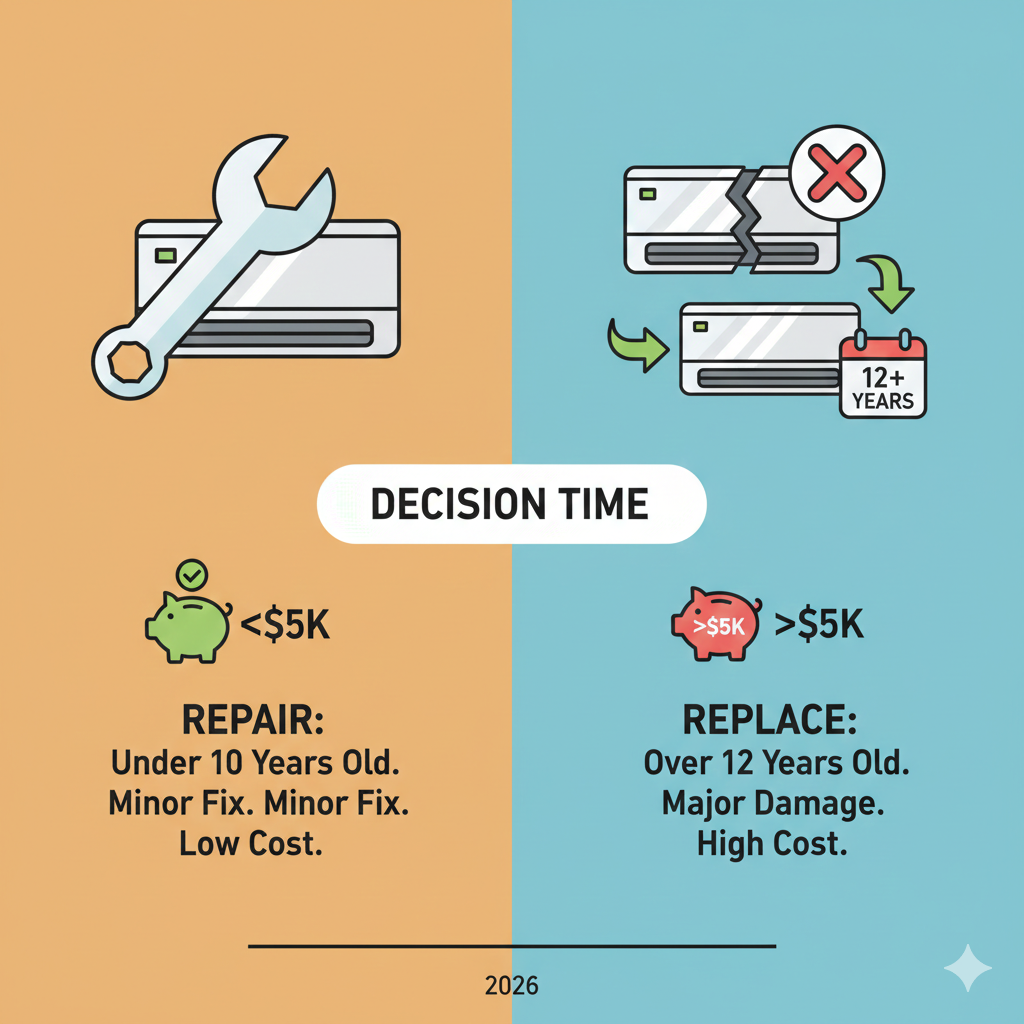
Experts use these two formulas to determine the most cost-effective path:
The $5,000 Rule: * Formula: $\text{Age of Unit} \times \text{Repair Cost}$
Result < $5,000$: Repair the unit.
Result > $5,000$: Replace the unit.
The 50% Rule: If the cost of a single repair is 50% or more of the price of a new system, replacement is generally the smarter investment.
Repairing is typically the best option if:
Age: The unit is less than 10 years old.
Warranty: The system is still under a manufacturer’s warranty (typically 5–10 years).
Minor Issues: Problems are isolated to simple components like:
Capacitors
Fan motors
Thermostats
Performance: The unit is reliable and currently meeting your home's cooling needs.
Short-term Plans: You plan to move or sell the home within the next 1–3 years.
Replacement is recommended if you experience any of the following:
| Category | Warning Signs |
| Lifespan | The unit is over 12–15 years old; efficiency is dropping. |
| Refrigerant | Uses R-22 (Freon) or R-410A (currently being phased down as of 2025/2026). |
| Major Failure | Compressor or condenser coil failure (costs often exceed $1,000–$3,000+). |
| Frequency | You have needed 3+ professional repairs in the last 3 years. |
| Efficiency | Utility bills have spiked significantly despite regular maintenance. |
| Safety | Severe electrical issues or potential fire hazards. |
If you choose to replace now, you may be eligible for significant savings:
Federal Tax Credits: High-efficiency units and heat pumps may qualify for credits under the Inflation Reduction Act.
Energy Savings: Upgrading from a 10 SEER unit to a modern 16+ SEER2 model can reduce annual cooling costs by 20–40%.